Drawing the Perfect Owl
Or: why Japanese startups continue to fail expectations.
There’s a meme that made the rounds in startup circles more than a decade ago, closer to when I first became a founder1:
Step one: Draw two circles.
Step two: Draw the rest of the fucking owl.
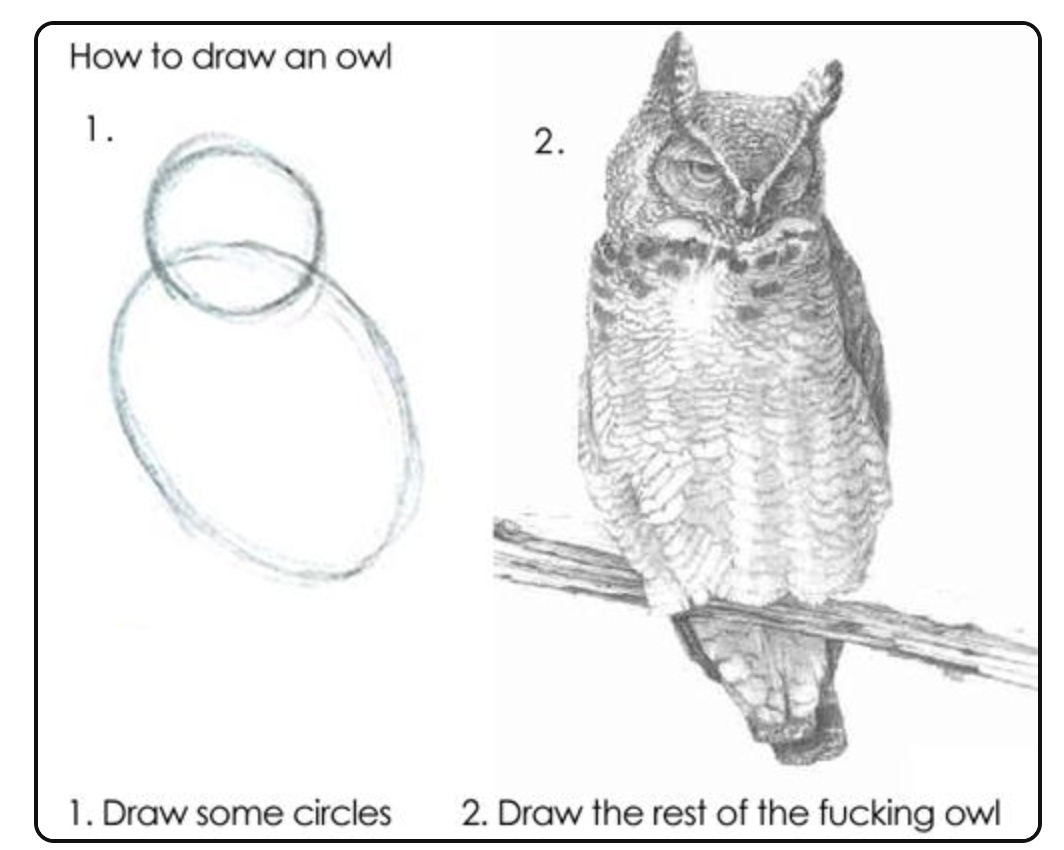
It resonates because it’s absurd - the gap between those two steps contains everything that matters - and it’s funny because it is so true. But here in Japan, especially out here on Rishiri Island, that gap isn’t a punchline. It’s where startups stop growing, and, occasionally, die.
The Japanese government wants startups to become unicorns. Tokyo VCs want founders to build global companies. Everyone’s gathered around, waiting for you to draw a beautiful owl. And all you know how to do is make two circles.
The Owl That Silicon Valley Knows How to Draw
In Tokyo, at least, startups have become almost normal. You can find the two-circle drawers easily enough - young founders who have been trained to make pitch decks2. What you can’t find are the people who know how to get from those two circles to the finished owl. The ones who’ve actually done it? You could count them on two hands. Maybe. The ones who could get you halfway there? Ten times that. But, still not many. They don’t pop into your co-working space, or overhear their nuggets sitting in a coffee shop. Tokyo is just too big. And startups, while becoming very cool, are the outlier anywhere else outside Tokyo.
This is the real gap between here and Silicon Valley. It’s not money; Japan has money. It’s not founders - we’re getting more every year. But we don’t have the tools and know how to take us from a rudimentary owl to the perfectly drawn one. It’s the accumulated knowledge of how to actually draw the dang owl. The pattern recognition. The scar tissue. The thousand small decisions that turn potential into reality.
And now some of Japan’s best founders - the ones with at least one win behind them - have decamped and headed to Silicon Valley. Not permanently, maybe. But long enough to learn how masters draw owls. They’re leaving because Japan can’t yet teach them what they need to know next3.
The Island Where Nobody Draws Owls
Back here on Rishiri, the problem intensifies. We’re not just far from Silicon Valley. We’re far from Tokyo. We are at the edge of Japan. Untamed. Owls circle around here. But there are basically no owl-drawers building startups.
But the expectations? Those don’t diminish with distance. If anything, they seem to grow. A solid contingent of our former team members, locals, and onlookers all expected the same thing: that we at Kamui should draw the perfect owl from the beginning. That I should’ve made the perfect company from the get go, as if I’d been secretly training with Picasso this whole time.
When I mess up - when my circles aren’t perfect, when I get the proportions lopsided, when the owl starts looking more like one of our fat-bloated crows - everyone watches. They don’t say anything, as is the Japanese way. But their eyes say everything. Why did you have the audacity to try drawing an owl at all? And why did you drag us into this artistic disaster?
Survival as Art Form
Given this general inability to draw owls perfectly (a condition I share with most startup founders), survival becomes the actual game. Not the elegant, always up-and-to-the-right growth that the startup-industrial complex has trained us on. Not the polished excellence that wins design awards. Just: make something actually good that people will keep coming back to this distant island for.
If you can survive long enough, something strange happens. The business grows anyway. Compounding works its quiet magic. More people discover your solution. More customers satisfied. Your knowledge of both your customers and your own business4 passes some invisible threshold to become a sustainable business. Your revenue and growth muscles develop through sheer repetition. You learn to dodge the mistakes, like a fighter who’s taken enough punches to finally learn how to slip them.
When I’ve run startups before, I was naive, very naive. I imagined I’d draw that perfect owl from day one. It never happened. Instead, each time the system just plopped me into the default mode, I always found myself in a game of survival. Survival isn’t a fun mode to operate in - it’s a long, lonely, dark tunnel with no clear light waiting for you. But I’ve made it through more than once with companies I’ve founded.
The shame is that survival became the mechanism that scaled my previous startups, rather than brilliance or crafty skill that you believed you must have to start building something anyway.
Somewhere in the Messy Middle
At this point, I still can’t draw the perfect owl. But I’m beyond just two circles, beyond that rudimentary owl everyone starts with. I’m somewhere in the messy middle - the owl has become more realistic, more dimensional, but it’s not a masterpiece yet. Just...closer.
To be clear I’m talking about company building here. Not our whisky. Our whisky, aging in this fierce wind, and pile of snow, is already a masterpiece.
With this team, though - and especially with Javier, our head distiller, who is a true artist- we have a real chance at drawing that perfect owl. Javier already knows how to draw beautiful things. Every spirit that comes off our stills proves it. He’s been drawing perfect owls, or near perfect owls, since he stepped off the ferry and set his first booted foot on Rishiri.
While I’m still trying to learn to draw that perfect owl, build that startup unicorn company that I believed would just happen when I started my founder journey, my daily job is more manageable. To foster the conditions where Javier can draw his owl. So somehow, someday this scrappy island distillery can become something that looks, from a distance, like it knew what it was doing all along.
Which Lines Matter
There’s a famous sequence of Picasso drawings- eleven lithographs showing a bull in progressive stages. The early ones are anatomically complete, beautifully rendered, perfect. By the end, they’re just a few lines. The absolute essence of a “bull” with everything else stripped away.
Supposedly this was Steve Jobs favourite.
It’s the same for startups, the same for drawing an owl. The perfect owl isn’t the realistic one, it’s the one where you’ve finally figured out which lines actually matter, which ones you can leave out.
This post was inspired by, and became a riff off: https://www.heavybit.com/library/video/executive-communication/
Could go on another rant: the over-emphasis on making the “perfect” pitch deck - fueled by an entire ecosystem of advice and consultants - has very little correlation, let alone causation, with building a good company..
Plot twist: many accomplished Silicon Valley founders, investors, and operators are now moving to Japan. Being one of the most attractive places to live imports world-class startup expertise amongst the inbound hordes.
Yes, in a startup you don’t really understand your own business. As a founder you need to learn it as quickly and deeply as possible. Another reason that perfect pitch deck exercise is mostly pirouettes.


